Enjoy 15% off all teas!

Arbutus Unedo Tea: Strawberry Tree Leaf Tea Guide
This guide serves as a comprehensive pillar resource on Arbutus Unedo tea or (Strawberry Tree) leaf tea, covering its history, botanical background, traditional preparation, taste profile, sustainability, and modern use. Related articles explore each topic in greater depth.
12/26/20258 min read
Introduction: Rediscovering a Forgotten Mediterranean Herbal Tea
In an era dominated by globalized wellness trends and mass-market herbal products, truly local and historically rooted botanical teas are becoming increasingly rare. While green tea, chamomile, and mint occupy supermarket shelves worldwide, countless traditional herbal infusions—once central to regional cultures—have quietly faded into obscurity.
Arbutus unedo tea, prepared from the leaves of the Strawberry Tree, belongs to this endangered category of botanical knowledge.
Native to the Mediterranean basin, Arbutus unedo has been part of local landscapes, folk traditions, and seasonal rhythms for centuries. Yet unlike commercially cultivated tea plants, this evergreen tree was never industrialized. Its leaves were gathered by hand, brewed at home, and shared within families—often without written records or formal documentation.
As a result, Arbutus unedo leaf tea remains largely unknown outside its native regions, despite its deep botanical heritage and long-standing traditional use.
This article was created to serve as the most complete, educational, and historically grounded reference on Arbutus unedo tea available online today. Rather than promoting exaggerated claims, it focuses on verified botanical facts, cultural context, and traditional preparation—presented in a clear, accessible, and search-engine-optimized format.
Whether you are a herbal tea enthusiast, ethnobotany researcher, or someone exploring rare Mediterranean infusions, this guide will take you deep into the story of the Strawberry Tree and its leaves.
What Is Arbutus Unedo?
Botanical Identity of the Strawberry Tree
Arbutus unedo, commonly known as the Strawberry Tree, is an evergreen shrub or small tree belonging to the Ericaceae family—the same botanical family as heather and blueberries.
It is native to:
Southern Europe
The western and central Mediterranean
Parts of North Africa
Coastal regions of the Middle East
The tree is instantly recognizable by its unique combination of features:
Leathery, glossy dark-green leaves
Small, bell-shaped white or pinkish flowers
Round, textured red fruits resembling strawberries
Despite its name, the Strawberry Tree is not related to true strawberries. The resemblance is purely visual.
While the fruit has attracted occasional culinary interest, the leaves of Arbutus unedo are the primary plant material traditionally used for herbal infusions.
Arbutus Unedo Tea Explained: A Herbal Infusion, Not True Tea
From a botanical and nutritional standpoint, Arbutus unedo tea is classified as a herbal infusion, not a true tea.
True teas—such as green, black, white, and oolong—are produced from the leaves of Camellia sinensis. Arbutus unedo tea, by contrast, is made by steeping dried Strawberry Tree leaves in hot water.
This distinction is important for both clarity and search intent.
Arbutus unedo leaf tea is naturally:
Caffeine-free
Non-fermented
Traditionally prepared without additives
Because of this, it is often sought by people looking for:
Caffeine-free tea alternatives
Rare or wild-harvested herbal teas
Traditional Mediterranean plant infusions
Natural Habitat and Geographic Distribution
Where Does Arbutus Unedo Grow Naturally?
Arbutus unedo thrives in environments shaped by centuries of minimal human intervention. It prefers regions where soil, climate, and biodiversity remain relatively undisturbed.
The Strawberry Tree is most commonly found in:
Mediterranean coastal zones
Rocky hillsides and slopes
Forest margins and scrubland
It frequently grows alongside:
Oak forests
Pine woodlands
Mediterranean maquis vegetation
The plant’s ability to flourish in poor, well-drained soils and withstand drought makes it a resilient species—well adapted to the Mediterranean climate.
This ecological resilience is one reason why Arbutus unedo has survived for millennia without domestication or large-scale farming.
Why Arbutus Unedo Tea Is Rare
Unlike most popular herbal teas, Arbutus unedo has never been widely cultivated for commercial use.
Several factors contribute to its rarity:
The tree grows slowly
Leaf harvesting must be done carefully to avoid harming the plant
Wild populations are scattered rather than concentrated
Traditional knowledge was passed orally, not industrially documented
As a result, Arbutus unedo leaf tea is typically:
Wild-harvested
Produced in small batches
Consumed locally rather than exported
This lack of commercialization has preserved the plant’s authenticity—but also limited global awareness.
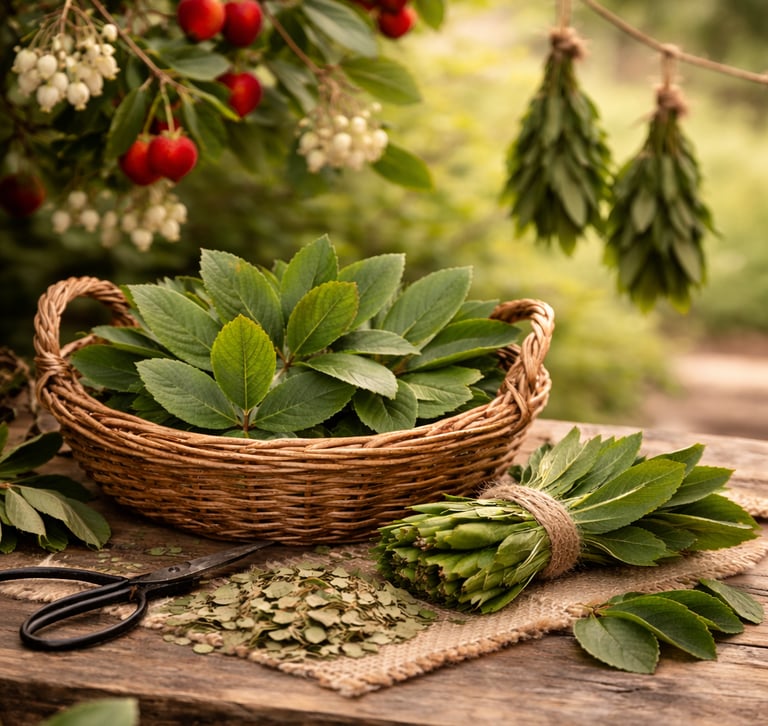
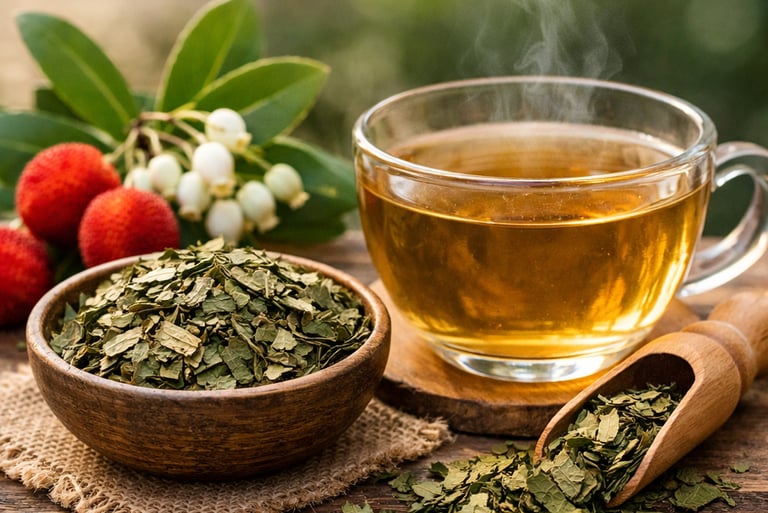
Freshly harvested Arbutus unedo leaves prepared for traditional Strawberry Tree leaf tea.
Get the free Strawberry Tree Ritual PDF when you join our email circle on the
The Historical and Cultural Roots of Arbutus Unedo Tea
The Strawberry Tree in Mediterranean History
Long before herbal teas were packaged, branded, or marketed, the Strawberry Tree was already embedded in Mediterranean life.
Ancient civilizations—including the Greeks and Romans—were well aware of Arbutus unedo. The tree appears in classical texts not as a novelty, but as a familiar presence in the natural landscape.
Its Latin name, unedo, is believed to derive from the phrase unum edo—“I eat only one”—a reference to the fruit’s mild flavor rather than to the leaves. This linguistic trace hints at how closely the tree was observed and named by early botanists.
While historical sources focus more on the fruit and wood, the use of leaves for simple water infusions likely developed quietly at the household level, especially in rural and mountainous areas where access to imported goods was limited.
Traditional Leaf Use in Folk Practices
In many Mediterranean regions, Strawberry Tree leaves were gathered seasonally and dried naturally—often hung in shaded, ventilated spaces.
The leaves were then used:
As standalone herbal infusions
As part of mixed botanical brews
Occasionally alongside other native plants
These practices were never standardized. Preparation methods varied by village, family, and climate, reinforcing the idea that Arbutus unedo tea belongs to living tradition rather than formal pharmacology.
A Tea Rooted in Place, Not Trend
What makes Arbutus unedo leaf tea unique is not just the plant itself, but the philosophy surrounding it.
This tea was never about:
Uniform flavor profiles
Global distribution
Wellness branding
Instead, it reflects:
Seasonal awareness
Respect for local ecosystems
Slow, intentional consumption
In today’s world, where herbal teas are often reduced to ingredients lists and health buzzwords, Arbutus unedo tea offers a rare counterpoint—a reminder that some botanical infusions exist simply because people lived close to the land.
The Leaves of Arbutus Unedo – Botanical Characteristics and Traditional Use
Understanding Strawberry Tree Leaves
The leaves of Arbutus unedo are the foundation of Strawberry Tree leaf tea. Unlike many soft or aromatic herbs, these leaves are thick, leathery, and evergreen, reflecting the plant’s adaptation to dry Mediterranean environments.
Key Botanical Features of Arbutus Unedo Leaves
Dark green, glossy upper surface
Lighter green underside
Oval to lance-shaped form
Firm, slightly waxy texture
Serrated or finely toothed edges
These characteristics serve a practical ecological function: they reduce water loss, protect the leaf from heat stress, and allow the tree to remain productive year-round.
From a tea-making perspective, this leaf structure influences:
Drying time
Infusion strength
Flavor extraction
Unlike tender herbs, Strawberry Tree leaves release their properties slowly, which is why traditional infusions are typically brewed longer than delicate leaf teas.
Why Leaves, Not Fruits, Are Used for Tea
While the Strawberry Tree fruit often draws attention due to its striking appearance, traditional herbal infusions focus almost exclusively on the leaves.
This preference developed for several reasons:
Leaves are available year-round
Harvesting leaves does not disrupt fruiting cycles
Leaves dry and store more easily
Leaf infusions offer consistency in flavor
Historically, fruit consumption was seasonal, while leaf use provided continuity—an important factor in rural Mediterranean households.
Seasonal Leaf Harvesting in Traditional Contexts
When Are Arbutus Unedo Leaves Collected?
In traditional practice, leaves are typically harvested:
In late spring or early summer
After the main flowering period
Before extreme summer heat
This timing ensures:
Mature leaf development
Lower moisture content
Reduced bitterness
Leaves are gathered selectively, never stripped entirely from a single branch—an early example of sustainable harvesting long before the term existed.
Taste Profile and Sensory Experience of Arbutus Unedo Leaf Tea
What Does Arbutus Unedo Tea Taste Like?
One of the most common questions asked by those discovering Strawberry Tree leaf tea is about flavor.
Arbutus unedo leaf tea offers a subtle, restrained sensory profile, very different from floral or aromatic herbal teas.
General Taste Characteristics
Mildly astringent
Earthy and woody
Slightly bitter, but balanced
Clean, dry finish
There are no overpowering notes or sweetness. Instead, the flavor reflects the plant’s natural environment—sun, soil, and air.
Many describe the experience as:
“Forest-like”
“Meditative”
“Quiet rather than expressive”
This makes Arbutus unedo tea particularly appealing to those who prefer minimalist, non-perfumed herbal infusions.
How Leaf Age Affects Flavor
Not all Strawberry Tree leaves produce the same infusion.
Younger leaves tend to yield a lighter, gentler brew
Older leaves produce a deeper color and more pronounced bitterness
Traditional users often blend leaves of different ages to create balance—a technique rarely mentioned in modern herbal tea discussions.
Traditional Preparation of Arbutus Unedo Leaf Tea
How Arbutus Unedo Tea Has Traditionally Been Brewed
Unlike modern tea culture, traditional Arbutus unedo leaf tea preparation was not precise or standardized. It followed instinct rather than measurement.
That said, common preparation principles emerged across regions.
Traditional Brewing Method
Dried Strawberry Tree leaves are lightly crushed
Hot (not aggressively boiling) water is poured over them
The infusion is covered and steeped
Tea is strained and consumed plain
Steeping times often ranged from 10 to 20 minutes, significantly longer than most herbal teas.
This slow extraction reflects the leaf’s dense structure and ensures full flavor release.
Why No Sweeteners Were Traditionally Used
Historically, Arbutus unedo tea was consumed without honey, sugar, or flavorings.
This was not a matter of preference alone—it was practical:
Sweeteners were scarce or expensive
The tea was viewed as functional, not indulgent
Flavor purity was valued
In modern contexts, some people choose to add honey or blend Strawberry Tree leaves with other herbs, but traditional use favored simplicity.
Arbutus Unedo Tea in Modern Herbal Culture
A Tea Rediscovered, Not Reinvented
As interest in wild and regional herbal teas grows, Arbutus unedo leaf tea is slowly re-emerging in:
Ethnobotanical research
Artisan herbal circles
Sustainable foraging communities
However, it remains far from mainstream—largely due to its slow-growing nature and limited availability.
This rarity has positioned Strawberry Tree leaf tea as a connoisseur’s infusion, valued more for authenticity than trend appeal.
Why Arbutus Unedo Tea Appeals to Modern Consumers
Today’s renewed interest is driven by:
Desire for caffeine-free alternatives
Interest in Mediterranean food heritage
Appreciation for low-intervention plants
Rejection of overprocessed herbal blends
In this sense, Arbutus unedo tea aligns perfectly with slow living and mindful consumption movements.
Sustainability, Ethics, and Responsible Harvesting
Protecting Wild Strawberry Tree Populations
Because Arbutus unedo is often wild-harvested, sustainability is essential.
Responsible practices include:
Harvesting small quantities
Avoiding young or stressed trees
Never stripping entire branches
Allowing regeneration between harvests
Traditional knowledge emphasized restraint—not abundance—a lesson increasingly relevant today.
Why Cultivation Remains Limited
The Strawberry Tree does not lend itself easily to industrial farming:
Slow growth rate
Specific soil requirements
Long maturation period
These constraints naturally limit overexploitation and reinforce its identity as a regional, small-scale botanical resource.
Frequently Asked Questions About Arbutus Unedo Leaf Tea
Is Arbutus Unedo Tea the Same as Strawberry Tea?
No. Strawberry Tree leaf tea is unrelated to strawberry fruit tea or flavored blends.
Does Arbutus Unedo Tea Contain Caffeine?
No. It is naturally caffeine-free.
Is Arbutus Unedo Tea Widely Available?
No. It is typically sourced from small producers or wild-harvested.
Can the Leaves Be Mixed With Other Herbs?
Yes, though traditionally it was consumed alone.
Where to Find Authentic Arbutus Unedo Leaf Tea
Because Arbutus unedo is slow-growing and rarely cultivated, finding genuine Strawberry Tree leaf tea can be challenging. Most mass-market herbal tea brands do not carry it, and quality varies significantly depending on harvesting and drying methods.
For readers looking for a small-batch, wild-harvested option, one available source is:
👉 Wild Strawberry Tree Tea (Arbutus Unedo Leaves) – organically harvested and traditionally dried
Conclusion: A Tea That Tells a Story
Arbutus unedo leaf tea is not a product of modern wellness culture. It is a reflection of landscape, history, and restraint.
In a world obsessed with novelty, this humble Mediterranean infusion offers something far rarer: continuity.
It reminds us that some of the most meaningful herbal traditions were never meant to be optimized—only respected.